Catalysts and buffers: How diversity and status in social networks shape attitudes towards inequality in contemporary societies
Abstract
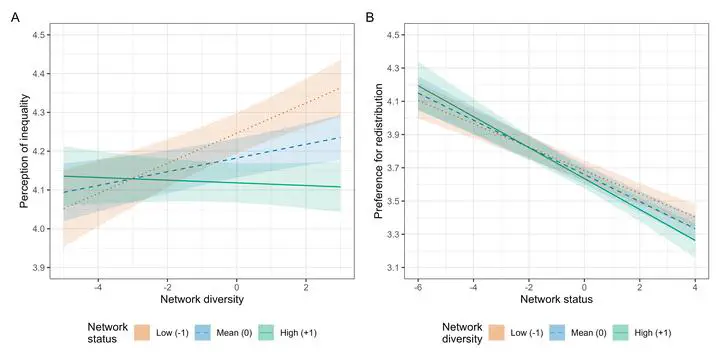
This paper explores how the socioeconomic composition of individuals’ social networks shapes attitudes towards inequality in contemporary societies. While limited cross-national research has examined the location of people’s acquaintances within the social structure, this study fills a crucial gap by jointly analyzing their heterogeneity and concentration. Using data from the ISSP 2017 Social Networks Module, the study investigates how socioeconomic network diversity and status relate to perceptions of inequality and preferences for redistribution across 32,310 individuals in 31 countries. Country fixed-effects regression results indicate that individuals with more socioeconomically diverse networks show modestly higher national inequality perceptions, whereas having higher-status acquaintances is strongly associated with lower support for redistribution. These effects are not uniform: network diversity often acts as a catalyst and network status as a buffer of distributive attitudes. Social networks thus operate simultaneously as comparative frames (highlighting disparities) and reference frames (anchoring norms), amplifying or dampening individuals’ views on inequality. Notably, network effects operate consistently across all socioeconomic groups, regardless of individuals’ SES. Overall, the study advances meso-level perspectives on distributive justice by demonstrating how everyday social relationships shape perceptions and beliefs about inequality in stratified societies.

Gonzalo Franetovic
Postdoctoral Researcher
Researching on how social inequalities are reproduced, reinforced, or contested through social relationships.