Different Paths, Diverging Views: The Formation of Inequality Attitudes Through Life Course Social Environments and Family Background
Abstract
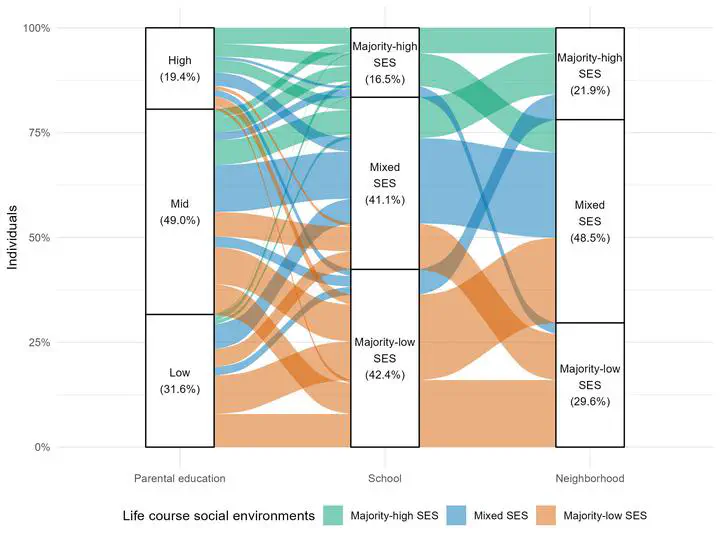
This article examines how life course social environments and family background influence individuals’ perceptions of inequality and egalitarian beliefs. While previous research has emphasized individual or national factors, this study highlights the meso-level dynamics of social contexts. By analyzing exposure over the life course to different socioeconomic groups within key socializing institutions, such as schools and neighborhoods, the study addresses a gap in the distributive justice literature that often overlooks past environments. Using retrospective survey data from a representative sample of the urban population in Chile and geocoded census information, the study estimates the socioeconomic composition of attended schools and current neighborhoods. It constructs a typology of life course social environments based on predominant exposure to majority-low, mixed, or majority-high socioeconomic status settings. The analyses show that exposure to mixed socioeconomic groups over the life course most strongly heightens perceptions of inequality, while exposure to majority-low socioeconomic environments primarily strengthens egalitarian beliefs. The influence on egalitarian beliefs is shaped by parental education, whereas the effect of life course social environments on perceptions of inequality remains consistent across groups. Individuals from higher-educated family backgrounds tend to report greater perceptions of inequality and stronger egalitarian beliefs, with parental education exerting a stronger influence than current social class and other factors. Overall, the study provides new insights into how family origins and social environments across the life course shape attitudes towards inequality, emphasizing the importance of considering both past and present conditions.

Gonzalo Franetovic
Postdoctoral Researcher
Researching on how social inequalities are reproduced, reinforced, or contested through social relationships.